WWDC26 Platforms State of the Union: A Developer Recap
The 2026 Platforms State of the Union outlines major advancements for developers across Apple’s ecosystem, focusing on three core pillars: Apple Intelligence, platform refinements, and developer productivity. Here’s what stood out.
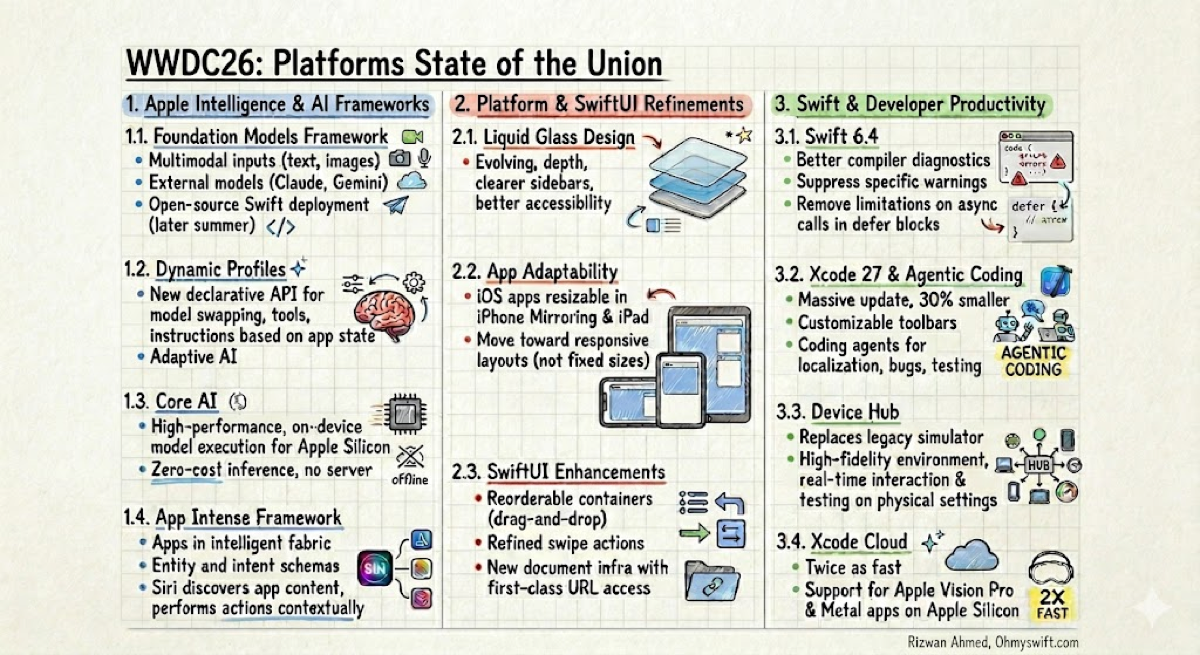
Apple Intelligence
Apple Intelligence took center stage, and this year the message is clear: you get more choice, less boilerplate, and tighter integration with the system. I really hope developers take full advantage of the new AI APIs provided by Apple.
Foundation Models Framework
The Foundation Models framework now supports image input alongside text, so multimodal experiences are a first-class path rather than a workaround. Apple also opened the door to server-side models like Gemini and Claude, which means you can pick the model that fits your use case instead of being locked into one approach.
On the tooling side, a new open-source package simplifies skills and context management — a welcome move for anyone who’s been stitching together prompt logic by hand. Dynamic Profiles are the other big addition: a declarative API for swapping models, tools, and instructions based on app state. Less code, more adaptive AI. That’s the kind of API design I like to see.
Core AI
If on-device inference is your priority, Core AI is worth watching. It’s a new framework built for high-performance, memory-safe model execution on Apple Silicon. Zero server cost, zero network dependency — just local inference tuned for the hardware your users already have.
App Intents
App Intents got a meaningful expansion this year. The goal is to weave your app into the system-wide intelligent fabric so Siri can reason over your content and actions, not just launch your app and stop there.
Updated entity and intent schemas, plus the new View Annotations API, give Siri richer context about what’s on screen and what the user can do next. If you’ve been holding off on App Intents because the payoff felt unclear, this is the year to revisit that decision.
Platform Improvements
The platform updates this year are less about dramatic rewrites and more about polish that compounds over time.
Liquid Glass Design
Liquid Glass continues to evolve. Refinements include better diffusion, darkened edges for depth, and more personalization options for users. The best part for developers: apps that already adopt these system features benefit automatically without recompiling. Ship once, look better on the next OS. Hard to argue with that.
SwiftUI
SwiftUI picked up several quality-of-life improvements that matter for real apps:
- Reorderable containers with drag-and-drop support
- Refined swipe actions that feel more native out of the box
- A new document infrastructure with first-class URL access for professional-grade file handling
If you’ve built file-heavy workflows in SwiftUI before, you know how much friction the old patterns had. This should help.
Swift 6.4
I know most of us are vibe-coding these days. But it is good to know what’s new in Swift 6.4 Swift 6.4 focuses on the day-to-day developer experience:
- Better compiler diagnostics (fewer cryptic errors, more actionable fixes)
- Support for
awaitindeferblocks - Simplified availability checks across platforms
Small changes individually, but they add up when you’re shipping across iOS, macOS, and the rest of the stack.
Hardware Transition
macOS is now fully transitioned to Apple Silicon. For developers, that means you can ship optimized, smaller binaries without carrying Intel compatibility baggage. The ecosystem has crossed the finish line.
Developer Productivity
The tooling story this year might be the most practical headline of the entire session.
Xcode 27
Xcode 27 beta arrives with a 30% smaller footprint, iCloud-synced settings, and a redesigned experience overall. The headline feature is Device Hub — a unified environment that merges simulator and physical device management. One place to run, inspect, and test instead of jumping between disconnected tools.
Agentic Coding
Xcode is now deeply integrated with coding agents. Apple demonstrated end-to-end workflows like generating feature plans, localizing apps using Strings Catalogs, and reproducing and fixing crashes — all from within the IDE.
This isn’t a bolt-on chat panel. It’s agents wired into the tasks you already do every week.
Extensibility
If you want to bring your own agent, the new Agent Client Protocol lets developers plug compatible agents into Xcode via plugins. Apple’s agents are the default, but you’re not locked in. That extensibility matters for teams with existing AI tooling or custom workflows.
What This Means for You
Three takeaways I’d keep in mind:
- AI is becoming a platform primitive, not a feature you bolt on. Foundation Models, Core AI, and App Intents are all pointing in the same direction — build intelligence into your app from the start.
- Platform polish is compounding. Liquid Glass and SwiftUI updates reward apps that stay current with system APIs.
- The IDE is catching up to how we actually work. Xcode 27 and agentic coding could change how you approach localization, debugging, and feature planning.
I’ll be digging into the individual sessions over the coming weeks and sharing deeper dives here. In the meantime, hit me up on LinkedIn or X with your take on WWDC26 — what are you most excited to try first?
About the author
- Rizwan Ahmed -
Developer Relations at Zoho Apptics | Tech Evangelist at Zoho | AI Researcher | iOS Engineer | Blogger at ohmyswift.com | Speaker | Mentor
LinkedIn - https://www.linkedin.com/in/rizwan95/
Twitter - https://twitter.com/rizwanasifahmed
Social media - https://bento.me/rizwan95
More articles
- Why Liquid Glass Is Making Developers Rethink Flutter
- Debug crashes in iOS using MetricKit
- SwiftUI in 2024: Bridging Perception and Reality
- From viewWillAppear to viewIsAppearing - Perfecting Your iOS View Transitions
- How to access SFSymbols directly in Xcode
- The Beautiful Chaos of Building Something Bigger Than Yourself

Like our articles? Support us!